Playback / The Breakfast Club
The Breakfast Club · 1985
Crackin' Skulls
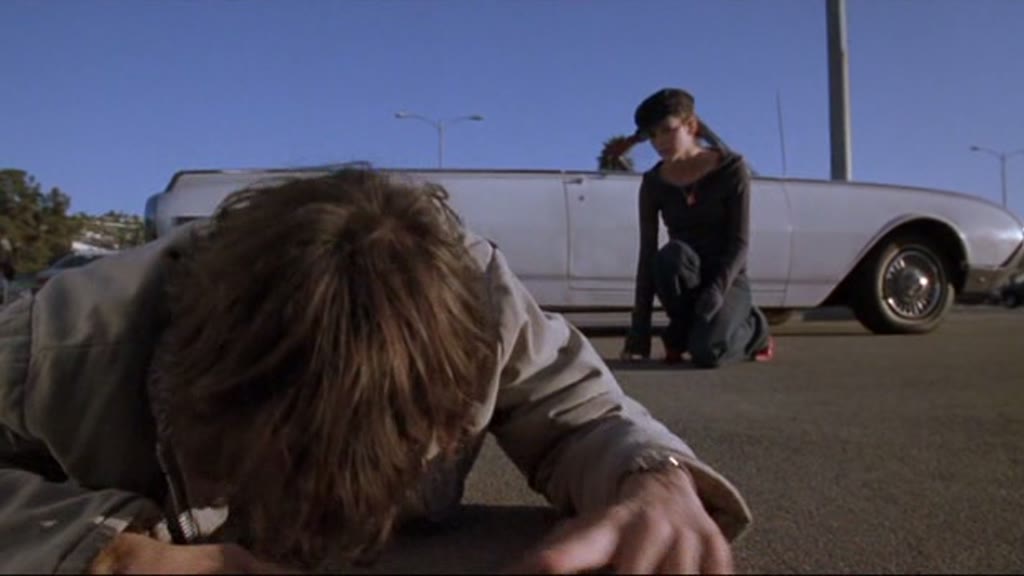
A low angle on Bender hands him the authority the principal is trying to claim.
Watch for
- The low angle on Bender that makes us look up at him as he taunts the principal.
- How the angle hands Bender the authority that Vernon — the actual authority figure — is trying to assert.
- The contrast in how the two are framed: who the camera looks up at, and who it does not.
A worked reading · COCA
CContention
Hughes uses a low camera angle to invert the real power dynamic, handing the rebellious student authority over the teacher.
OObservation
As Bender provokes him, Bender is shot from a low angle so the camera looks up at him, while Vernon is framed more neutrally.
CConnotation
Looking up at a figure conventionally reads as dominance and control, so the angle visually crowns Bender even though Vernon holds the institutional power.
AAudience
We are positioned to side with Bender's defiance and to feel the teacher's authority as hollow, reinforcing the film's sympathy for the students.
Your turn
- Who does the camera look up at, and who does it hold level? What does that tell us about power?
- How would re-shooting Bender from a high angle change the way we read him?
- Camera angle is doing characterisation here — what is it telling us about Bender without dialogue?
For teachers
A clean, classroom-friendly example of camera angle and power — ideal for Year 9–10. Pairs directly with the Camerawork page (shot angle).